
Does Chasing Ultimate Safety Make Us Weaker? Unpacking Risk, Resilience, and Self-Defense Jiu Jitsu


In a world obsessed with bubble-wrapping every corner of life, it's easy to forget that true strength often blooms from the edge of uncertainty. Picture this: You're cruising through the latest episode of *The Joe Rogan Experience* #2412 with Adam Carolla, and around the 1:50 mark, the conversation ignites. Carolla riffs on the absurdity of over-engineered car safety features—like mandatory backup cameras that treat drivers like toddlers—while Rogan chimes in on how society's fear-mongering around everything from COVID to climate change turns us into paralyzed spectators. "It's always about, how am I making money by scaring you about safety," Carolla quips, highlighting how regulations meant to protect us often stifle innovation and real progress. Rogan nods along, pondering the sweet spot: How safe is safe enough? And what payoffs—personal growth, breakthroughs, that electric thrill of living—do we sacrifice by playing it too safe?
This exchange hit me like a well-timed armbar. As someone deeply immersed in self-defense training at Self Defense Academy Colorado Springs, where we teach the practical, no-nonsense Valente Brothers Jiu Jitsu method, it sparked a burning question: Does our relentless optimization for safety go too far? Can we truly safety-proof the world, or are we just building fragile shells around resilient spirits? In this post, we'll dive deep into the real-world ripple effects, back it with research from both sides of the debate, and explore how self-defense Jiu Jitsu in Colorado Springs offers a grounded path to empowerment. If you're searching for Jiu Jitsu classes near me or wondering how to build real-world confidence without the fluff, stick around—this is for you.
The Real-World Trap: When Safety Becomes a Straitjacket
Let's face it: We've all seen it. The helicopter parent hovering over the playground slide, the office riddled with warning labels for every conceivable mishap, or the urban jungle where jaywalking feels like a federal offense. In Colorado Springs, with its rugged peaks and vibrant downtown, we cherish our freedoms—hiking trails without guardrails, spontaneous road trips through the Rockies. Yet, societal pressures creep in, turning everyday adventures into calculated checklists.
Take building codes in places like Los Angeles, as Carolla laments in that Rogan episode: Insane regulations designed to prevent one-in-a-million disasters end up pricing out affordable housing and grinding progress to a halt. Closer to home, think about our sanitized schools and sanitized lives. Post-COVID, playgrounds in some districts banned tag games to avoid "roughhousing risks," leaving kids starved for the very chaos that builds coordination and grit. We can't safety-proof the world because life isn't a lab experiment. Earthquakes don't RSVP, muggers don't follow scripts, and neither do the curveballs of daily existence. Over-optimizing creates a false paradise—one where a scraped knee feels like Armageddon, and we're ill-equipped for the inevitable storm.
This isn't hyperbole. In our hyper-connected era, algorithms amplify every hazard: A viral TikTok about "toxic" playground mulch, and suddenly, everyone's swapping mulch for memory foam. But here's the kicker—what if this quest for zero risk is eroding our collective backbone? As we'll see from the science, it just might be.
The Science of Safety: A Double-Edged Sword
Research paints a nuanced picture: Safety measures save lives, but push them to extremes, and you court unintended consequences. Let's break it down, citing studies that champion safety's wins and warn of its pitfalls.
The Upside: How Safety Culture Fuels Performance
No one's arguing against seatbelts or fire alarms—they're non-negotiable. A 2021 study in the International Journal of Environmental Research and Public Health found that strong safety cultures in workplaces reduce psychosocial hazards like stress and burnout, boosting overall performance by up to 20%. In construction or manufacturing, optimizing safety protocols—think ergonomic designs or hazard simulations—cuts injury rates dramatically, per ASCE's engineering guidelines. These aren't luxuries; they're lifelines that let us focus on thriving, not surviving.
The Downside: The Paradox of Overprotection
Flip the coin, and the cracks show. Enter the "hygiene hypothesis" and its psychological twin: Over-sterilizing our environments doesn't just weaken physical immunity—it atrophies our mental resilience. A 2025 review in Frontiers in Immunology argues that excessive hygiene and overprotectiveness disrupt microbial exposure, leading to higher rates of autoimmune disorders and allergies in kids raised in "too-clean" homes. It's the immune system's version of bench-pressing feathers: No challenge, no gains.
Psychologically, it's even starker. Psychology Today explores the "paradox of protective parenting," where hyper-vigilant shielding from minor threats paradoxically erodes a child's sense of security, spiking anxiety by 30-40% in overprotected teens. Brad Stulberg's work echoes this: Over-optimizing for control breeds fragility, turning adaptable humans into brittle systems that shatter under real pressure. In AI parallels (because why not?), over-optimization leads to "unpredictable model behavior," much like how our fear-driven policies spawn black-swan vulnerabilities we never saw coming.
The verdict? Safety is a tool, not a throne. When it dominates, we trade vitality for vulnerability.

The Payoff of Risk: Why a Little Danger Goes a Long Way
Rogan and Carolla nail it: Risk isn't the enemy—stagnation is. That 1:50 timestamp dives into how calculated gambles, like tweaking car designs without turning vehicles into tanks, spark innovation. "Balancing safety and risk fosters growth," they agree, touching on how over-sanitization dulls our natural defenses. Science backs the buzz.
Studies show risk-taking rewires the brain for the better. Carnegie Mellon's cognitive psych research reveals that embracing uncertainty—say, public speaking or a new hobby—enhances decision-making under stress, reducing cortisol spikes by 25% over time. A 2024 Medium roundup of five powerhouse studies links it to stronger hearts (via adrenaline-fueled cardio), sharper cognition (dopamine hits from wins), and even lower depression rates—risk-takers report 15% higher life satisfaction.
For adolescents, it's gold: NIH-funded work on "positive risk-taking" (think skateboarding) builds autonomy and emotional regulation, curbing reckless behaviors long-term. Therapy Changes adds that it forges confidence, uncovers opportunities, and instills pride—benefits no padded cell can match. In short, risk is the gym for your soul: Skip sessions, and you atrophy.
Self-Defense JuJutsu: Your Antidote to the Safety Trap
So, how do we reclaim balance in a padded world? Enter self-defense JuJutsu—not the sporty rolls of competition BJJ, but the street-smart, leverage-based system taught at Self Defense Academy Colorado Springs. Rooted in the Valente Brothers Method, our classes blend ancient Jujutsu with modern efficiency: Simple techniques that turn an attacker's strength against them, no superhuman power required.
Why Jiu Jitsu for safety? It embodies the "Goldilocks" approach—not reckless exposure, but controlled chaos. You learn to fall safely (ukemi), escape chokes, and submit threats with poise, building muscle memory for the unpredictable. Research aligns: Martial arts training slashes perceived vulnerability by 40%, per psych studies on empowerment, while honing situational awareness that over-reliance on apps (like personal alarms) can't touch.
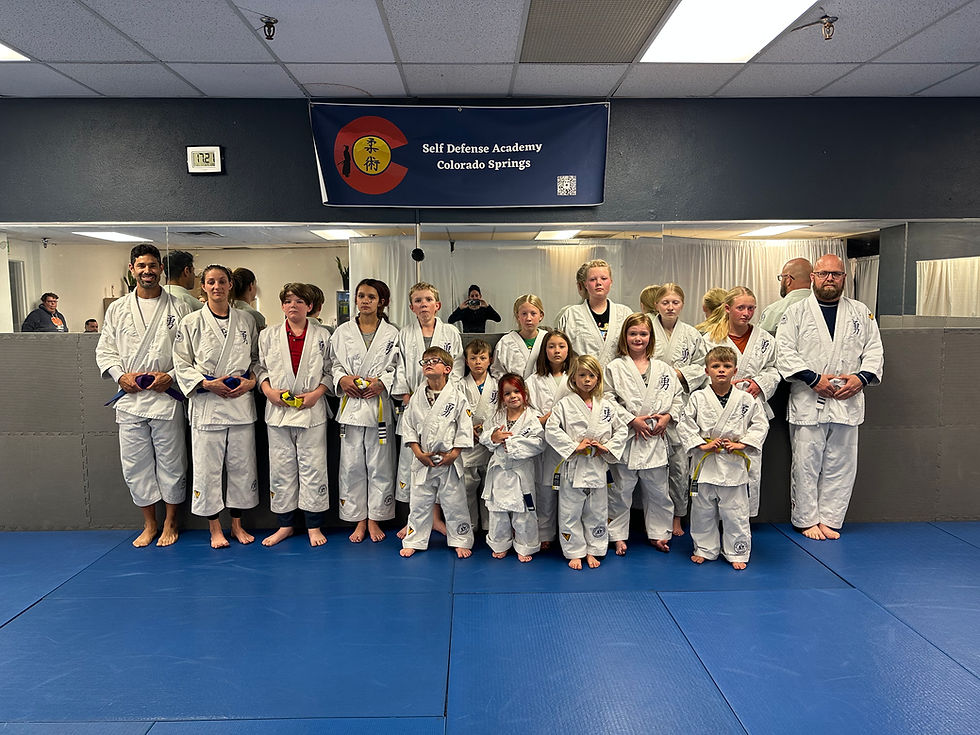
At our downtown spot—525 North Cascade Avenue, right in the heart of Colorado Springs—we're not churning out cage fighters. We're forging confident Coloradans who hike Pikes Peak without paranoia, and parents with presence, not panic. Beginners? Welcome. Families? We've got flows for all. It's Jiu Jitsu that prepares you for risk, so safety feels earned, not enforced.
Imagine channeling Rogan's curiosity and Carolla's candor into a roll: That "aha" moment when a guard pass clicks, mirroring the thrill of a calculated bet paying off. It's not about inviting danger—it's about dancing with it.
Ready to Embrace Risk and Build Resilience?

We can't safety-proof the world because it's not built for perfection—it's built for participation As Rogan and Carolla unpack, the real payoff lies in measured risks: Innovation, joy, unbreakable grit. Ditch the bubble wrap; step onto the mat.
If you're in Colorado Springs and craving self-defense classes that deliver real results, hit up Self Defense Academy COS today. Book a complimentary trial session. Discover the Valente Brothers JuJutsu difference—where safety meets strength, and risk becomes your superpower.
What's your take? Too safe, or just safe enough? Drop a comment below, and let's spar (verbally, of course). Stay fierce. YOU Are Worth Defending! Does Chasing Ultimate Safety Make Us Weaker? Unpacking Risk, Resilience, and Self-Defense Jiu Jitsu
Thought of the Moment: "I've learned that the safest path is not always the best path and I've learned that the voice of fear is not always to be trusted." — Adam Silvera


Comments